Frequently Asked Questions
You’ve got questions – we’re here to help!
Click the Question to expand
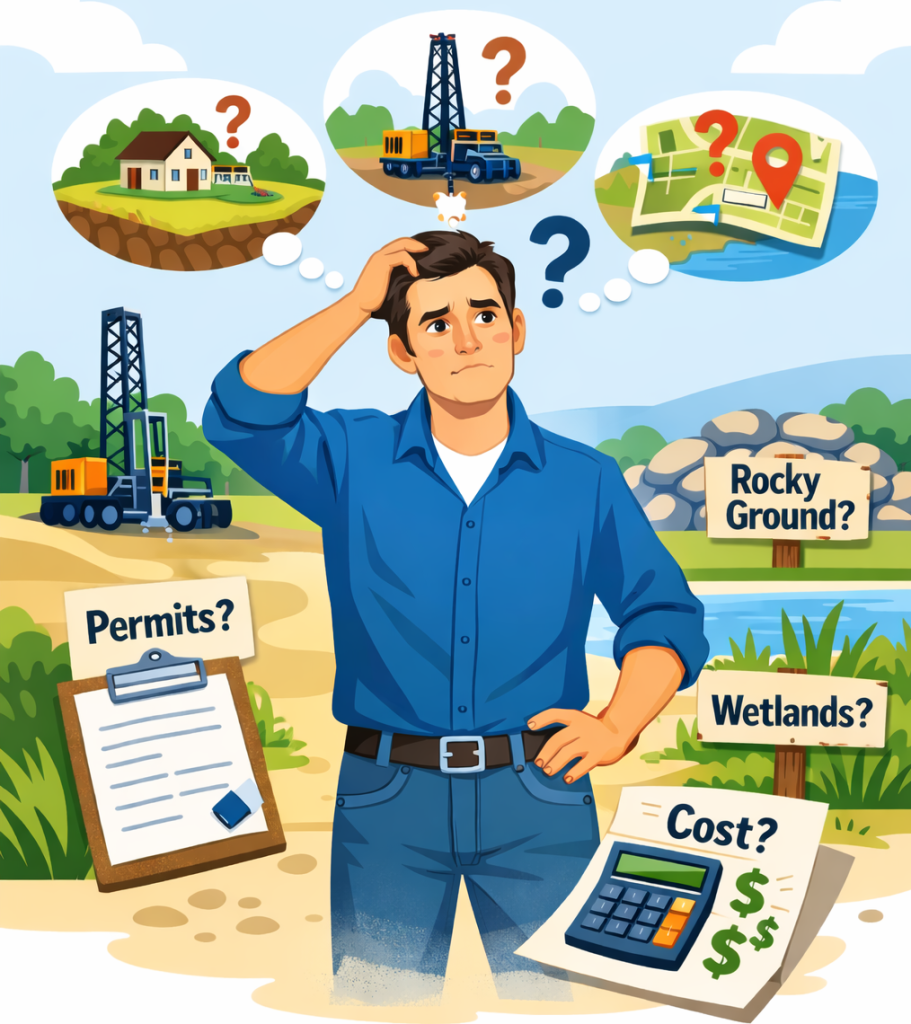
How and where do I drill a water well?
- Selecting the well location is the first and most critical phase of property development. There are specific setback requirements that need to be recognized and respected. These setbacks are site-specific and can vary from county to county, and property to property.
- TIP: Generally when starting with undeveloped land a septic system designer is a helpful resource to determine where placement will be in an approved location, the location of your well will be determined by your septic design.
- What to expect from Arcadia Drilling: Our knowledgeable staff is here to help you along the way. When you hire Arcadia Drilling to drill your new well these are the steps to expect:
- All contract documents are to be signed and returned to Arcadia Drilling. Once received, you will be invoiced for the initial deposit agreed upon in the contract.
- Upon receipt of deposit, Arcadia Drilling will file a Notice of Intent to drill with the Department of Ecology.
- The well location will be selected, likely by the septic designer and owner. Although our team can be involved on request.
- The well location will be marked, and an access road will be established for drilling equipment. Verified by our team in person and/or through shared photos.
- Our project manager will coordinate the drilling schedule with you.
- Once the well is drilled, our team will discuss the pump selection with you and will schedule the pump crew to set the pump, sanitize the well and take water samples.
- The water samples will be delivered to the lab by Arcadia Drilling. Upon receiving the lab results, Arcadia Drilling will send you an email with attached lab results.
- The water well report from the driller will become available soon after and will also be sent to you via email or USPS.
- For a more comprehensive description see the ‘Get Well Educated’ section below or contact our office with any questions you may have.
How much does it cost to drill a water well?
- The price to drill a new well is generally determined by how deep the well is. However, depth and the ‘price per foot’ does not fully encompass how much a well costs. Other factors to consider are:
- The pump and associated equipment
- The pressure control system
- Contact Arcadia Drilling for a free quote so that you can budget with confidence. Visit our Financing page if you’re interested in options to finance your project.
Do I need a permit to drill a well?
- WA State Department of Ecology: Does not require a permit. They do require a ‘Notice of Intent’ to drill, it must be filed properly and when completed the original document (Water Well Report) is submitted to their office.
- Counties: Each county agency determines if they will require a permit to approve the location before drilling.
- TIP: Because requirements vary from county to county and from site to site, we recommend contacting either your County Healthy Department or call our office to understand your site’s specific requirements. We are happy to help you navigate this sometimes confusing process.
- For more detailed information and links to WA state departments, check out the ‘Get Well Educated’ section below.
Why is my well water pressure low? Is my water pump failing?
- Low water pressure can be very disappointing. There can be a number of factors causing low pressure:
- Do you have some pressure but just very low?
- You likely have a leak somewhere. The leak could be in any of the water lines or even down the well
- Other factors may be a failing pump or changing conditions in your well.
- Do you have no water or pressure at all?
- First thing to check is your electrical breaker panel. Locate the breaker switch that operates your pump, flip it completely off and then back on.
- If you still have no water pressure you will need a pump technician to diagnose the problem and perform any needed repairs
- Do you have some pressure but just very low?
- It is always best to have an experienced pump technician assess the situation to determine the actual cause and recommend the best solution. We have a very knowledgeable and experienced team of well pump technicians that can help you. Contact our office right away so we can get your water pressure back to where it should be!
What size pump and pressure tank do I need?
- The size of the well pump is generally determined by the following factors:
- Depth of the well (determined during the drilling process)
- Static water level inside the well (the well’s “resting” water level before any pumping occurs)
- Intended use of the well (such as domestic supply, irrigation, industrial, etc)
- Pressure control systems options:
- Conventional/Standard pressure tank: Provides reliable but fluctuating pressure. Commonly installed in a pump house.
- Variable Frequency Controller (Constant pressure system): Provides steady, more constant pressure. Allows for more versatile installation options
- TIP: Contact Arcadia Drilling’s knowledgeable staff. We would be more than happy to help you determine what specific pump horsepower and gallon-per-minute flow rate is the best fit for you. We can also discuss your options for a pressure control system that will work for you.
Get “Well” Educated!
Additional information and resources to help you understand the process
Where should I drill my well?
We are asked this question by our customers more often than any other question. There are several factors we need to take into consideration when choosing a well site. They usually fall into two categories, regulatory and practical.
Washington State and certain Counties have rules and ordinances that will restrict certain areas from construction of wells. The Department of Ecology is the State agency that regulates well drilling. The Washington Administrative Code for well drilling is Chapter 173-162 WAC. Section WAC 173-160-171 “What are the requirements for the location of the well site and access to the well?” contain the setbacks from sources or potential sources of contamination that must be met.
Regulatory Site Requirements:
Generally, the well cannot be closer than 50′ from the farthest extension of the building including eaves. 50′ from sewer lines including septic lines, septic tanks, septic or sewer pump chambers and other conveyance systems of waste water. 100′ from drain-fields, proposed drain-fields of drain-field reserve areas and any other source or potential source of contamination not already mentioned except solid waste landfills. 1000′ from any solid waste land fill active or inactive. Variances to these setbacks may be obtained with the help of professional geologist or hydro-geologist.
Certain County governments have setbacks of their own that can be more restrictive than those found in WAC 173-160-171. They also include setbacks from streams, wetlands, property lines and other sensitive areas. Many of these counties have a well site approval process that includes paper work and fees. The counties with the most restrictive setbacks include Pierce, Kitsap, and Thurston, and if you are in King county they have restrictions that are second to none. If you need or want help in navigating the many confusing and convoluted State and County rules and regulations E-mail Jason and he will be happy to lend you his expertise in this field.
Practical Site Requirements:
In locating a well site we need to keep certain practical things in mind. First and foremost should be legal access. Do we need to cross other people’s property to reach yours? Do you have the proper easements for ingress and egress in place? If not then you may need to solicit the help of an attorney in obtaining these.
Drill rigs and service vehicles can weigh in excess of 60,000 lbs. Will the roads and other soils that must be crossed support those weights? If not you may need to add rock or other ballast to the site to support the drill rig and service vehicles.
Another thing to keep in mind is future development. The well will need to be serviced from time to time. Do you plan to build or plant between the well and the driveway that will block access to the well? Will your pump and tank be housed inside a pump house and will the roof of your pump house be removable to accommodate vertical access for future repairs or maintenance? All of these questions need to be addressed prior to selecting a well site.
The thing most people want to know is, will I find water on this spot? It is very difficult determine how deep a well will be or how much water a well will make prior to drilling. The best information will come from checking the Dept. of Ecology’s Well Logs for the surrounding area. Talking to neighbors who have wells is also a great way to get valuable information. The Washington State Department of Ecology has a web site where you can search Well Logs in your area. We also have extensive records on wells we have drilled in our office. Call our office or E-mail Jason for help in determining the viability of your land for well drilling.
Well Water Treatment:
Have water stained fixtures, hardness and scale, or “tea” colored water?? Click here to learn more about common well water quality issues, causes, and effects. Arcadia Drilling does not offer filtration services but we work closely with experienced water treatment professionals and would be glad to point you in the right direction.
Click on the button below to visit our recommended water filtration service partner American Pump & Drilling: